
Turning Japan Africa Corporate Collaboration into Businesses That Scale
Cross border collaboration is often presented as an opportunity. The harder question is how to make it work in practice.
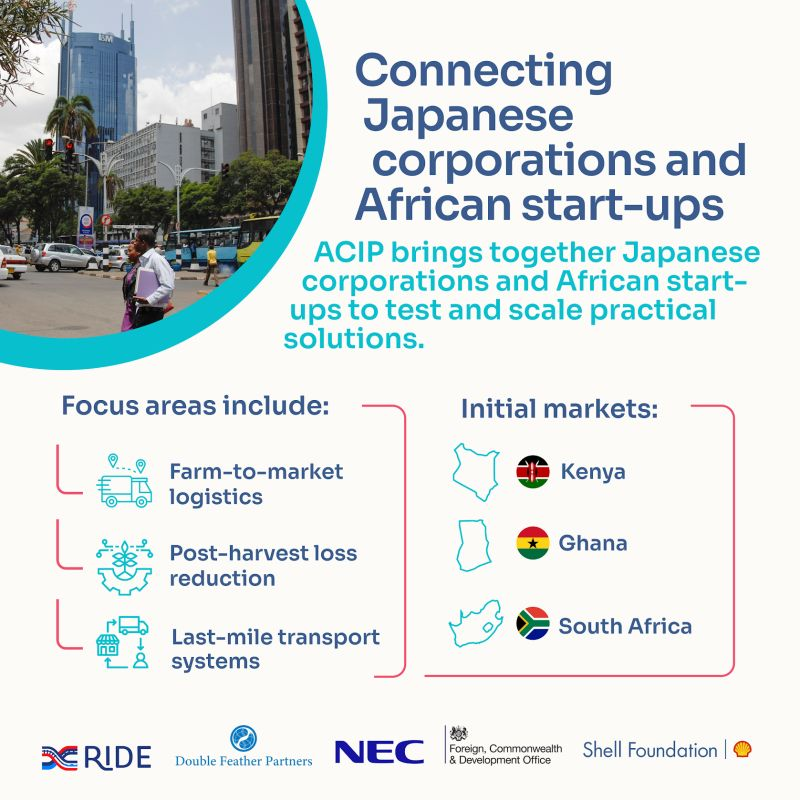
The Africa Corporate Innovation Program (ACIP), launched by Shell Foundation in partnership with Double Feather Partners and NEC Corporation, is designed around that question. The programme brings Japanese corporate capabilities together with African startup innovation, creating a structured pathway from initial collaboration and proof of concept through to commercialisation and potential investment.
For DFP, this is an important extension of our work connecting Japanese companies with African markets. Rather than treating market entry as a standalone advisory exercise, ACIP creates a practical mechanism for companies to test solutions alongside local startups and learn from real operating environments.
From Pilot to Commercial Partnership
The programme is built around proof of concept projects that allow startups and corporate partners to work together on specific market challenges. This can involve adapting technologies to local conditions, testing business models with customers, understanding operational requirements and generating evidence that can support a larger commercial deployment.
The initial programme focuses on areas including agriculture, logistics and mobility. Projects are expected to address practical challenges such as farm to market logistics, post harvest losses, supply chain management, traceability and last mile transportation. Initial markets include Kenya, Ghana and South Africa, alongside a wider group of African countries identified as having potential for future scale.
The intention is not simply to complete a successful pilot. The programme is designed to create a pathway from a successful demonstration towards longer term business relationships and additional capital.
Where DFP Fits In
DFP is responsible for designing and implementing the programme, drawing on our experience working with more than 130 African startups and supporting corporate and startup collaboration across the continent.
Our role spans the process from defining corporate challenges and identifying relevant startups through to structuring proof of concept projects, supporting implementation, measuring impact and connecting successful pilots with investment and scale up opportunities.
This is an important distinction. A corporate pilot can demonstrate that a technology works, but that does not necessarily mean it can become a sustainable business. The work between those two points is often where the greatest challenges sit. A solution may need to be localised, the economics may need to be redesigned, procurement processes may need to change and additional financing may be required before a pilot can become a commercial relationship.
ACIP is designed to address these practical issues as part of the process rather than treating them as problems to solve later.
Why Catalytic Capital Matters
Early stage collaboration carries risk for both sides.
Startups may invest significant time and resources adapting their products to a corporate environment without certainty of a commercial outcome. Corporates may be hesitant to commit significant resources before they have evidence that a solution works in their market.
The programme is supported by the UK government through the Foreign, Commonwealth and Development Office via the Research on Infrastructure in Developing Economies programme, alongside Shell Foundation. This catalytic support helps reduce some of the risk associated with early stage collaboration and creates stronger conditions for follow on investment and commercial scale.
This blended approach is particularly relevant in markets where a commercially promising solution may still require substantial testing before private capital is ready to participate.
A Different Model for Japan Africa Collaboration
The opportunity extends beyond individual pilots.
Japan has significant expertise in areas such as technology, manufacturing, mobility, logistics and industrial systems. African startups bring local market knowledge, entrepreneurial speed and solutions developed around the realities of African customers.
Bringing these capabilities together can create something that neither side could develop as effectively on its own. For Japanese companies, working with African startups can provide a faster route to understanding local markets and testing new business models. For African startups, corporate partnerships can provide access to technology, customers, distribution networks and expertise that can accelerate growth.
NEC is the first Japanese corporate partner in ACIP, with the programme designed to create opportunities for additional Japanese companies to participate over time.
What We Hope to Build
The real measure of ACIP will not be the number of pilots completed. It will be whether those pilots lead to lasting commercial relationships, investment and measurable improvements for businesses and communities across African markets.
That is why DFP sees the programme as more than an innovation initiative. It is an implementation platform designed to connect corporate innovation with local entrepreneurship and capital. Our objective is to help create a repeatable model where Japanese companies can move from interest in Africa to practical market engagement, while African startups gain credible pathways to corporate customers, commercial scale and investment.
The first phase of ACIP will generate important lessons about what works, where adaptation is required and how successful models can be expanded. Those lessons can help shape future collaborations across mobility, logistics, agriculture and other sectors where Japanese technology and African entrepreneurship can create meaningful commercial value.
For Double Feather Partners, this is the opportunity we see ahead: building a stronger bridge between Japanese corporate capabilities and African innovation, with a clear path from collaboration to business creation and long term growth.