
Building Kenya’s E-Mobility Ecosystem Through Skills Development
The transition to electric mobility requires more than vehicles and charging infrastructure. It also requires the people, skills and businesses capable of operating, maintaining and scaling the new mobility ecosystem.
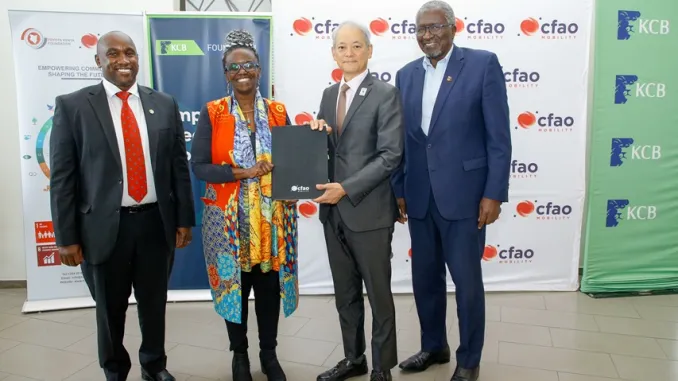
A strong example of this is the partnership between KCB Foundation and CFAO Mobility Kenya, which is equipping 200 young Kenyans with hands-on automotive and e-mobility training through the Toyota Kenya Academy.
The programme brings together complementary capabilities. CFAO Mobility Kenya contributes technical and automotive industry expertise, while KCB Foundation brings its focus on entrepreneurship, financial literacy and access to finance.
Together, these components create pathways that extend beyond technical training, helping participants develop the skills and resources required to pursue employment, entrepreneurship and business ownership within a rapidly evolving mobility sector.
Developing the Workforce Behind Electrification
As electric vehicles become more common across Kenya, the demand for appropriately trained technicians and operators will grow.
Electric vehicles require different technical knowledge from conventional internal-combustion vehicles, including expertise in high-voltage systems, batteries, electric drivetrains, diagnostics and charging equipment.
Developing this talent early is therefore critical to ensuring that the growth of electric mobility is supported by a workforce capable of maintaining and servicing the vehicles entering the market.
The opportunity extends beyond employment.
As Kenya’s e-mobility ecosystem develops, there will be growing demand for entrepreneurs and small businesses operating across areas such as vehicle servicing, battery maintenance, charging infrastructure, fleet management and other mobility-related services.
Providing young people with both technical capabilities and business knowledge can help ensure that more of the economic value created by electrification is captured locally.
The Importance of Access to Finance
The combination of skills development with financial literacy and access to finance is particularly relevant.
Training someone to become a technician or entrepreneur is only one part of creating a sustainable pathway into the mobility economy. Access to capital can determine whether those skills can ultimately be translated into a viable business.
By combining technical training with entrepreneurship and financial support, programmes such as this have the potential to bridge the gap between learning a skill and building a livelihood around it.
This becomes increasingly important as new mobility technologies create business opportunities that did not exist within the traditional automotive ecosystem.

A Japan–Africa Collaboration Opportunity
The initiative also highlights the growing potential of Japan–Africa collaboration in mobility and workforce development.
Toyota’s global automotive expertise, combined with CFAO Mobility Kenya’s local market presence and KCB Foundation’s experience in youth development and financial inclusion, provides a strong platform for transferring technical knowledge while adapting it to Kenya’s specific market needs.
For the wider e-mobility ecosystem, these partnerships can help build the human infrastructure required to support electrification at scale.
DFP Perspective
At Double Feather Partners, we see skilled technicians and entrepreneurs as an essential part of Africa’s transition to electric mobility.
The conversation around e-mobility often focuses on vehicle adoption, charging infrastructure and financing. These are critical, but they cannot operate effectively without the people and businesses needed to build, maintain and manage the ecosystem.
Kenya’s growing electric mobility market will require a new generation of technicians, fleet operators, entrepreneurs and service providers who understand both the technology and the commercial realities of running an electric mobility business.
Initiatives such as the KCB Foundation and CFAO Mobility Kenya programme are therefore important not only as youth-development initiatives, but as investments in the underlying human capital of Kenya’s emerging e-mobility sector.
As electrification accelerates across Africa, developing this workforce will be just as important as deploying the vehicles and infrastructure themselves.
Congratulations to KCB Foundation and CFAO Mobility Kenya on this important initiative.